Workouts / 3 min read
A Simple Resistance-Band Workout for a Small Space
A resistance band and a clear patch of floor are enough for a compact, full-body strength session. This practical routine pairs lower- and upper-body moves, gives beginner-friendly set and rep targets, and explains…
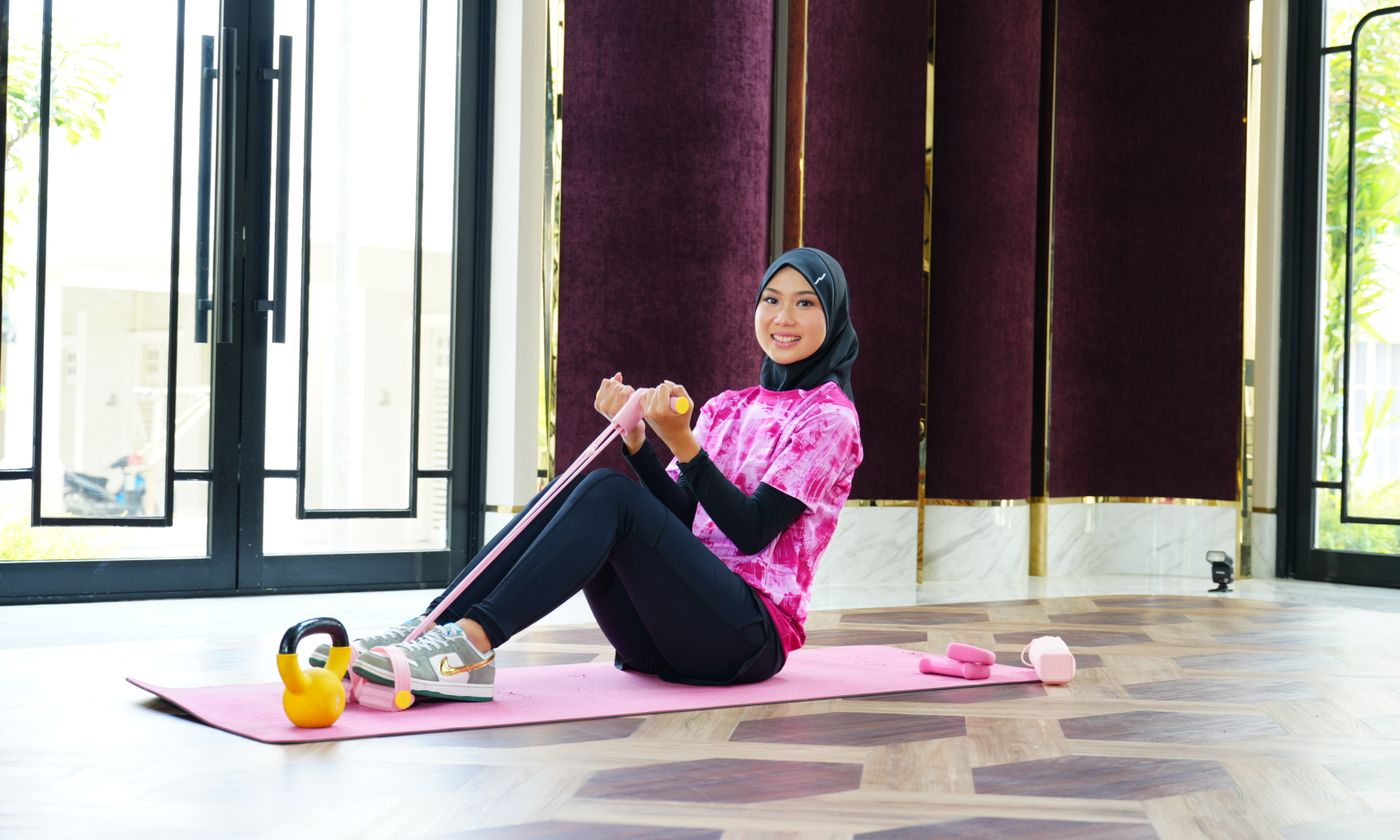
A resistance band and a clear patch of floor are enough for a simple full-body workout at home. Try the five moves below in order, completing 2 sets of 8–12 controlled repetitions per exercise; rest about 60–90 seconds between sets. Choose a band that lets you finish each set with steady form, while the last few reps feel challenging—not forced. These sets and rest times are practical suggestions, not a research-prescribed program.
The small-space workout
You’ll need a long resistance band; a mini-band is optional. The routine needs roughly enough floor space to stand, hinge, and lie down. Anchor-free options avoid relying on a door or furniture.
| Exercise | How to do it | Main focus |
|---|---|---|
| Band squat | Stand on the middle of the band, feet about hip-width apart, holding an end in each hand at shoulder height. Sit your hips down and back, then stand. | Legs and hips |
| Standing band row | Sit with legs extended, loop the band around your feet, and hold an end in each hand. Pull elbows back toward your sides; return slowly. | Back and arms |
| Band chest press | Wrap the band around your upper back, holding an end in each hand. Press forward from chest height, then bring hands back under control. | Chest, shoulders, arms |
| Band Romanian deadlift | Stand on the band with feet hip-width apart and hold the ends. Push hips back with a soft bend in the knees; stand by bringing hips forward. | Back of legs and hips |
| Kneeling band shoulder press | Kneel on the band and hold its ends near your shoulders. Press overhead without arching your lower back; lower slowly. | Shoulders and arms |
For each move, keep the band secure and check it for tears before starting. Stop if you feel sharp pain, numbness, or dizziness. If a movement is uncomfortable, shorten the range or skip it; seek qualified guidance if you’re unsure what is appropriate for you.
Make the workout fit your level
If 8 reps feel difficult to control, use a lighter band or reduce the range of motion. If 12 reps feel easy, try a stronger band, stand wider on it, or slow the lowering phase. Change one thing at a time so you can tell what makes the exercise harder. Keep a steady pace and leave a little room before your form breaks down.
This routine is a practical way to cover several major muscle groups, but it doesn’t replace every kind of activity. The CDC recommends that adults get muscle-strengthening activity on at least 2 days each week, alongside aerobic activity; resistance bands are one option for strengthening. (cdc.gov) A systematic review and meta-analysis of healthy adults also examined elastic-resistance exercise and muscle strength, though this short example should not be treated as a tested protocol from that review. (pubmed.ncbi.nlm.nih.gov)
Keep it social—or repeat it solo
Try the session two days a week, with a rest day between if that suits your schedule. If you’d rather have company for a neighborhood walk or another activity after your workout, Actively helps adults find nearby workout partners and active friends through shared activity interests, mutual matching, and chat. It’s for connecting with people, not for coaching or workout logging.
Sources & further reading
- CDC: Adult Activity — An OverviewChecked October 24, 2026
- Effects of Elastic Resistance Exercise on Muscle Strength and Functional Performance in Healthy Adults: A Systematic Review and Meta-AnalysisChecked October 24, 2026
Prepared with AI assistance by Actively Editorial. Read our sourcing and corrections policy. General educational information; individual needs vary.